
Tv Mounting Height Calculator
The most common TV-mounting mistake is hanging the screen too high. This calculator uses your screen size, how you sit and how far away you are to find the right height for the centre of the screen, where the bottom edge lands, and where to fix the wall bracket — and it tells you when a higher position (over a fireplace or in a bedroom) needs tilt.
- Free to use
- No sign-up
- Runs in your browser
TV mounting height calculator
TV Mounting Planner Pack
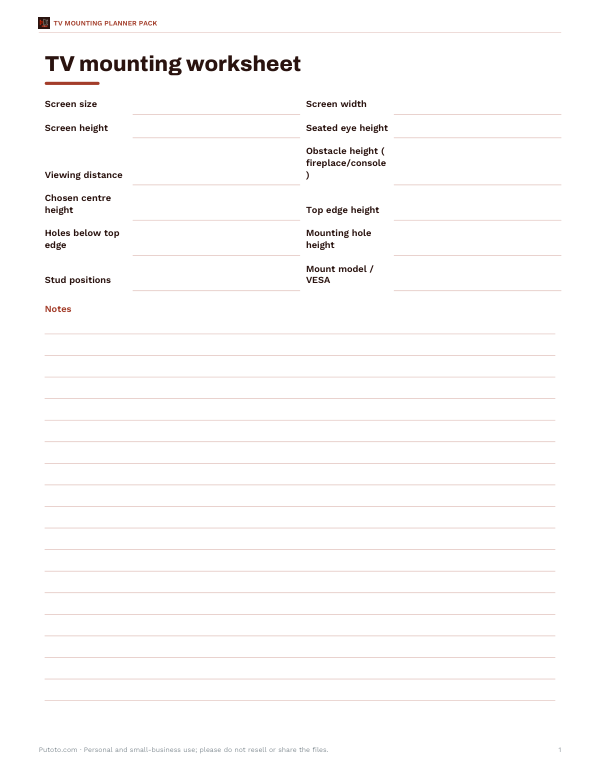
Printable TV mounting planner: height and bracket worksheet, screen size and viewing distance chart, and an installation checklist.
- Mounting worksheet (PDF/DOCX)
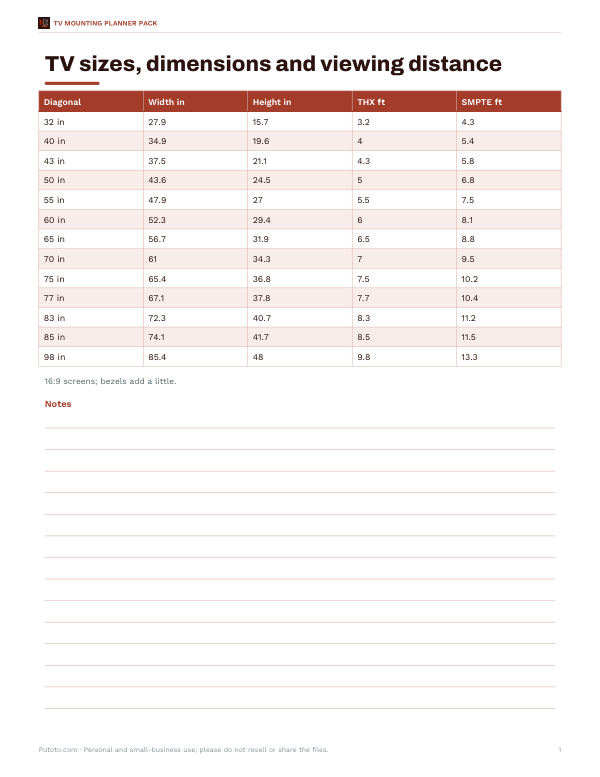
- Screen size chart (PDF/XLSX)
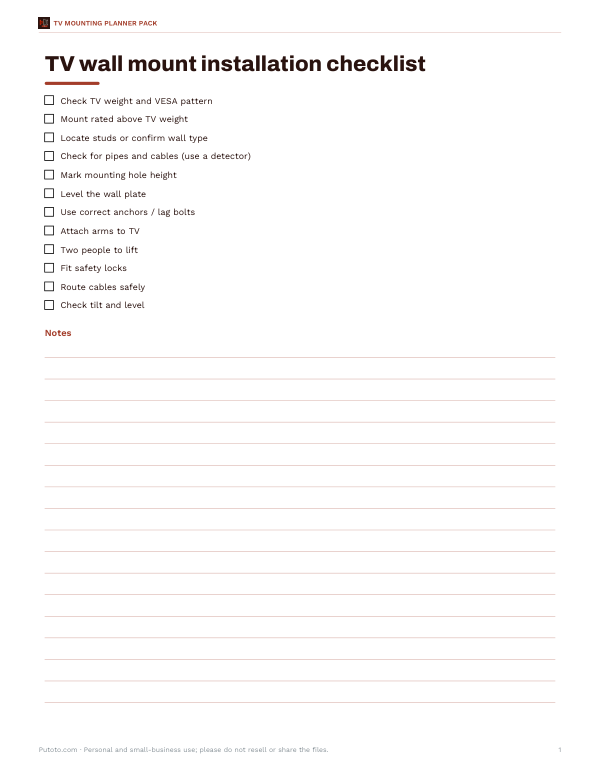
- Installation checklist (PDF/DOCX)
Formats: PDF, DOCX, XLSX. Instant download after payment (link valid 72 hours, up to 5 downloads). AI-assisted: the templates were drafted with AI help and reviewed and laid out before publishing.
$5.00 USD, one-time 3 files · about $1.67 each
- Instant download
- 7-day refund
- Secure checkout by Stripe
7-day money-back guarantee. Full refund within 7 days of purchase, even after you download.
Full refund within 7 days — see the refund policy and license.
Free printables
Single sheets you can print right now, no sign-up. The full pack adds every sheet in one download plus the editable files.
The rule of thumb: centre at eye level
For comfortable viewing, the centre of the screen should be close to the eye level of the main viewer when seated — typically about 40–44 inches (100–110 cm) from the floor for a sofa. Looking slightly down is easier on the neck than looking up. Many guides suggest keeping the upward angle to the centre of the screen below about 15°, and some suggest no more than 30° to the top edge.
Typical centre heights by screen size
| Screen | Width × height (16:9) | Centre at 42 in → bottom edge | Top edge |
|---|---|---|---|
| 43 in | 37.5 × 21.1 in | 31.5 in | 52.5 in |
| 50 in | 43.6 × 24.5 in | 29.7 in | 54.3 in |
| 55 in | 47.9 × 27.0 in | 28.5 in | 55.5 in |
| 65 in | 56.7 × 31.9 in | 26.1 in | 57.9 in |
| 75 in | 65.4 × 36.8 in | 23.6 in | 60.4 in |
| 85 in | 74.1 × 41.7 in | 21.2 in | 62.8 in |
Larger TVs keep the same centre height, so their bottom edge sits lower. If a console or soundbar must fit underneath, the TV may need to go higher — which is when the viewing angle check matters.
Finding the bracket position
- Decide the centre height (from the calculator).
- Add half the screen height to get the top edge.
- Measure how far below the top edge the TV’s mounting holes are (or check the manual).
- Subtract that from the top-edge height: this is the height of the mounting holes on the wall.
- Now look at your bracket: most wall plates have a range of vertical adjustment — mark the wall plate position so the TV arms line up with that hole height.
- Mark stud positions (or use anchors rated for your wall type and the TV’s weight) and check level before drilling.
Enter the hole distance in the calculator for the exact fixing height.
Worked example
A 65-inch TV is 56.7 inches wide and 31.9 inches tall. With a sofa eye height of 42 inches, the centre goes at 42 inches, the bottom edge at 26.1 inches and the top at 57.9 inches. If the mounting holes are 12 inches below the top edge, they sit 45.9 inches from the floor. Over a fireplace whose mantel is 54 inches high, the bottom edge must be at least 54 inches, pushing the centre to 69.9 inches: from 8 feet away that is about 16° above eye level, so a tilting mount angled down about 15° helps, while a lower mounting location would be more comfortable for long viewing.
Viewing distance
| Screen | THX (~40° view) | SMPTE (30° view) |
|---|---|---|
| 43 in | 4.3 ft | 5.8 ft |
| 55 in | 5.5 ft | 7.5 ft |
| 65 in | 6.5 ft | 8.8 ft |
| 75 in | 7.5 ft | 10.2 ft |
| 85 in | 8.5 ft | 11.5 ft |
Film and cinema standards recommend a field of view of about 30° (SMPTE) to 40° (THX). Sitting closer is fine with 4K and 8K screens because the pixels are too small to see; many people now choose screens larger than these figures suggest.
Over a fireplace
- Check the heat: a TV above a working fireplace can overheat — manufacturers usually specify maximum operating temperatures; feel the wall with the fire lit for an hour.
- Use a tilting or pull-down (mantel) mount to bring the screen closer to eye level.
- Consider cable routing and outlet placement behind the TV, following local electrical rules.
- Masonry chimney breasts need suitable anchors; avoid drilling into flues.
Bedrooms, kitchens and gyms
In a bedroom, you usually watch reclined against pillows, so your eyes are higher than the mattress but your line of sight tilts upward — a higher mount with some downward tilt suits this. In kitchens and gyms, viewers stand, so the centre can go at standing eye height, roughly 60–65 inches (150–165 cm).
Corner, swivel and ceiling mounts
A full-motion (articulating) mount lets you pull the screen out and swivel it toward different seats or into a corner; the calculation is the same, but measure the viewing distance from where you will usually sit. Corner installations need a mount designed for corners or one with long arms. Ceiling mounts are used in kitchens, bars and bedrooms; set the drop so the screen centre still aims at eye level and use tilt to face the viewers. For all movable mounts, check that cables are long enough for the full range of movement.
Safety
Use a mount rated for more than your TV’s weight and VESA pattern, fix into studs, solid masonry or anchors rated for the load, and follow the mount’s instructions. Anti-tip straps are important for TVs on furniture, especially where there are children. If in doubt, use a professional installer.
Frequently asked questions
How high should I mount a 65 inch TV?
With a typical sofa, put the centre about 42 inches from the floor — the bottom edge about 26 inches and the top about 58 inches.
How high should a TV be mounted in a bedroom?
Higher than in a living room, with some downward tilt, since you watch reclined.
Is a TV over a fireplace too high?
Often — check the viewing angle; above about 15° a tilting or pull-down mount helps.
What is the best viewing distance for a 55 inch TV?
About 5.5–7.5 feet by THX and SMPTE guidance; closer is fine for 4K.
How do I find where to put the bracket?
Top edge height minus the distance from the TV’s top edge to its mounting holes.
Are my measurements saved?
No. They stay in your browser.